Carbon Steel or Stainless Steel for Outdoor Electrical Enclosures? We’ve Seen What Happens When the Wrong Material Is Used

Julian Zheng,[email protected]
2026-08-07
On This Page
Introduction
When people start an outdoor enclosure project, one of the first questions is usually:
“Should we use powder-coated steel or stainless steel?”
There is no single answer.
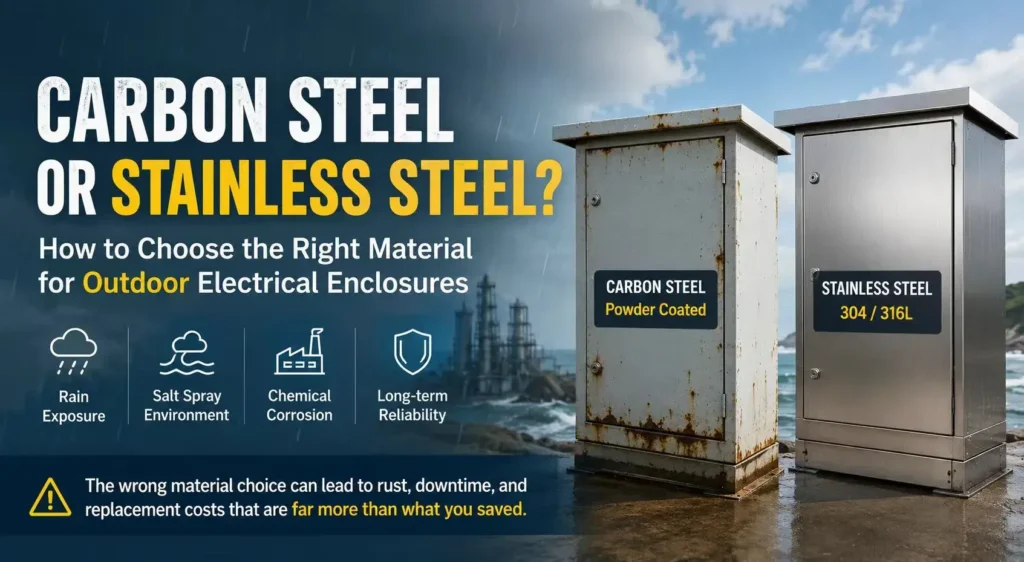
The most important thing is not whether the enclosure is simply “outdoor.” What really matters is where it will be installed and what kind of environment it will face every day.
If that part is judged incorrectly, the money saved at the beginning can easily turn into much higher costs later.
Powder-Coated Steel Can Be Completely Fine Outdoors
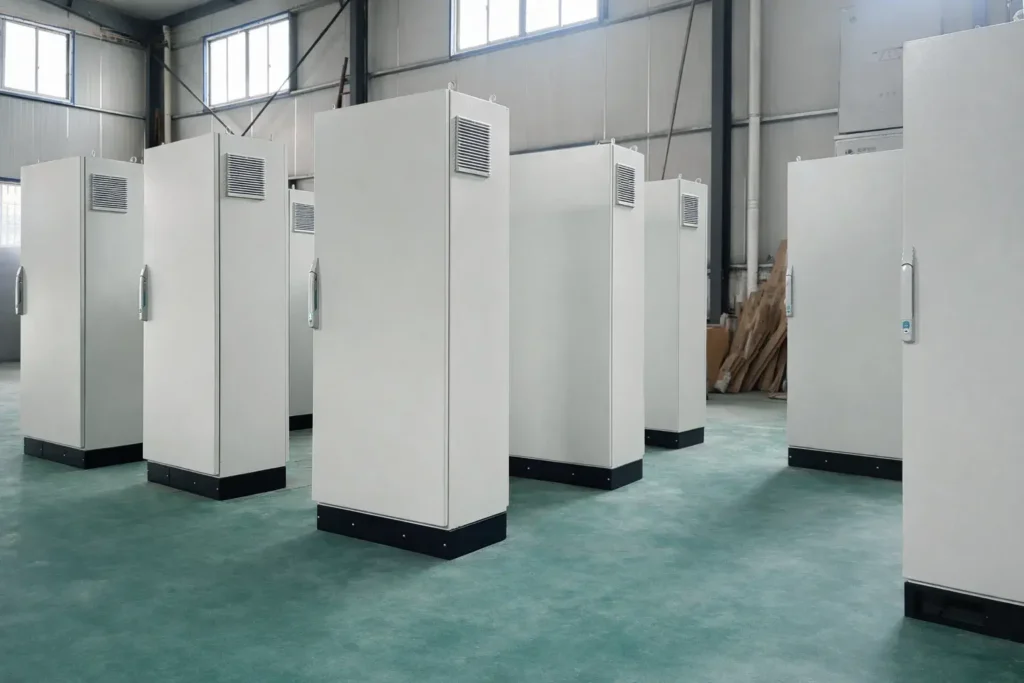
If the enclosure is installed in a normal outdoor area, especially under a canopy or in a place where it is not constantly exposed to rain, powder-coated cold-rolled steel can work very well.
We have supplied many enclosures like this, and some have been in service for seven or eight years without serious corrosion problems.
So the problem is not that carbon steel is “bad.”
The real question is whether the environment is suitable for it.
For ordinary outdoor industrial applications, a properly fabricated and powder-coated steel enclosure can be a very practical and cost-effective solution.
Chemical Plants, Coastal Areas and Heavy Rain Are Different
Once the environment becomes more aggressive, the material choice changes quickly.
For example:
- Chemical plants
- Coastal areas
- Locations with heavy salt spray
- High-humidity environments
- Installations that are frequently exposed to direct rain
In these conditions, we normally do not recommend treating the enclosure like a standard outdoor cabinet.
For this kind of application, 304 stainless steel should usually be considered the starting point.
If the environment is even more severe, 316L stainless steel may be the better choice.
This is especially important in coastal and chemical environments, because corrosion is not always obvious at the beginning.
The enclosure may look fine when it is first installed. It may still look acceptable after one year. But corrosion keeps developing over time.
By the time you can clearly see blistering, rust or perforation, the damage may already be serious.
One Customer Tried to Save Money — and Paid Much More Later
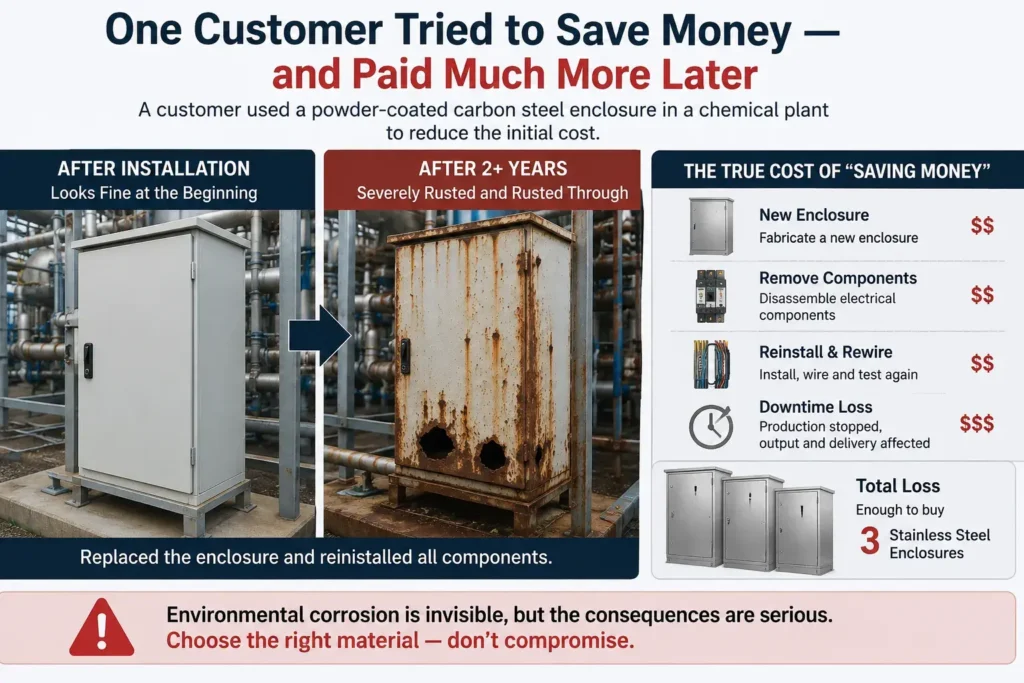
We had one customer who used a powder-coated carbon steel enclosure in a chemical plant to reduce the initial project cost.
At first, there was no obvious problem.
But after a little more than two years, the enclosure had corroded badly and rusted through in some areas.
At that point, replacing the cabinet itself was only part of the cost.
The customer also had to:
- Manufacture a new enclosure
- Remove the existing electrical components
- Reinstall the components
- Rewire and recommission the system
- Deal with downtime during the replacement
In the end, the total loss was enough to buy three stainless steel enclosures.
That is why we do not like choosing enclosure materials based only on the initial price.
We first want to know one thing:
Where will the enclosure actually be installed?
That answer is often more important than the material name on the quotation.
316L Is Not Always Better Either
The opposite mistake also happens.
Stainless steel is not automatically the right choice for every outdoor enclosure, and 316L is not automatically better than 304 for every project.
If an enclosure is installed in a normal industrial environment, protected by a canopy and not exposed to serious corrosion, specifying 316L may simply increase the project cost without adding much real value.
The material should match the environment.
A simple rule of thumb is:
| Installation Environment | Typical Material Choice |
|---|---|
| Indoor industrial environment | Powder-coated steel |
| Normal outdoor area with canopy | Powder-coated steel is often sufficient |
| Outdoor area with frequent rain exposure | Consider SS304 |
| High-humidity or corrosive environment | SS304 or higher |
| Coastal / heavy salt-spray environment | SS316L recommended |
| Chemical plant / severe corrosion | Evaluate SS316L based on actual conditions |
This is only a general guide.
For a real project, the actual installation conditions should always be checked before the material is finalized.
The Biggest Mistake Is Saying “It Should Be Fine”
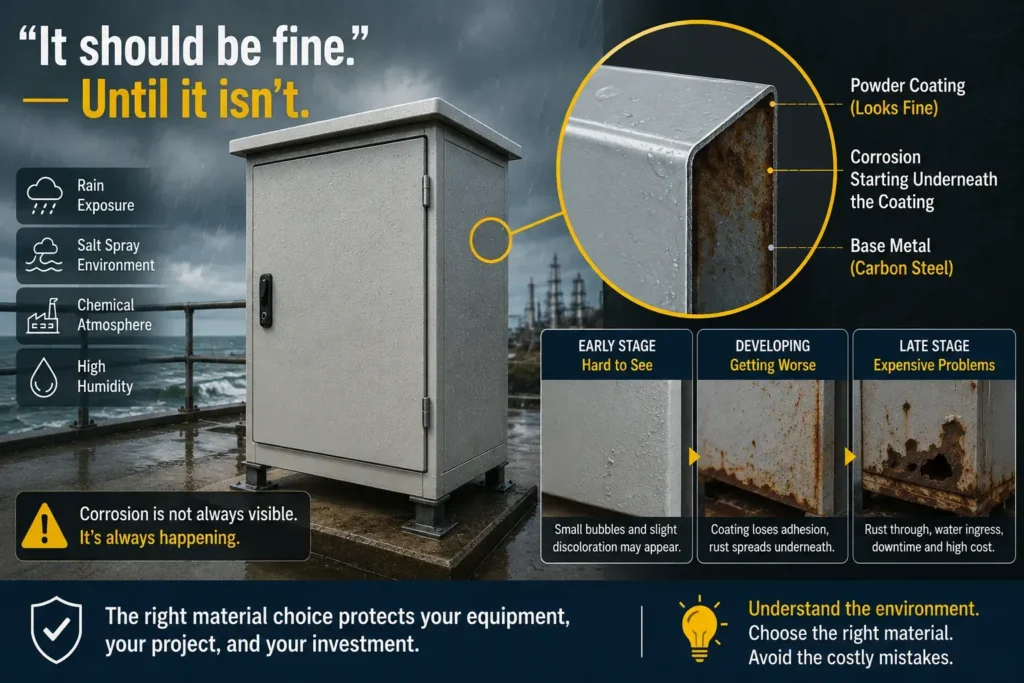
When it comes to corrosive environments, material selection is not a good place to compromise.
Corrosion is difficult because you often cannot see it coming.
You cannot touch it or measure it just by looking at the cabinet on the first day, but it is still there.
Whether an enclosure lasts seven or eight years, or begins failing after only two or three years, can sometimes be decided at the material-selection stage.
So before choosing between powder-coated steel, 304 stainless steel and 316L stainless steel, first understand the installation environment.
Save money where it makes sense. But if the environment requires a better material, the money you save today may cost much more later.